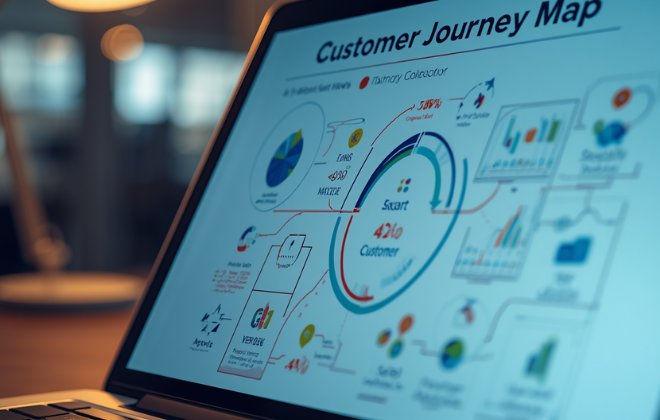
How Do You Map the Customer Journey? A 2026 Step-by-Step Guide
How do you map the customer journey? By creating a visual representation of every interaction a customer has with your brand, from the moment they first discover you through their entire relationship with your business. A customer journey map helps you understand what your customers are doing, thinking, and feeling at each stage of their experience.
This guide walks you through what customer journey mapping is, why it matters, and how to create your own map step by step.
What Is Customer Journey Mapping?
A customer journey map is a visual representation of every step a customer takes when interacting with your brand. It can be a simple timeline of touchpoints or a more detailed diagram that captures emotions, pain points, and opportunities. The goal is to help you understand each interaction throughout the buying process, design better experiences, and improve outcomes.
Unlike funnel diagrams that focus only on conversion steps, journey maps show the full experience, not just the moments of purchase. What looks smooth internally often feels fragmented from the customer’s perspective. A simple task, like finding help or completing a purchase, can involve delays, repeated steps, or unclear next actions.
Why Customer Journey Mapping Matters in 2026
Consumer behavior has shifted significantly. According to Salesforce’s 2024 State of the Connected Customer report, 80 percent of consumers say the experience a brand provides is as important as its products or services. Companies that excel in end-to-end journey management see 20 to 30 percent higher customer lifetime value.
Without a clear view of the journey, friction points are easy to miss. They show up as drop-offs, repeated questions, or frustration that teams cannot always explain. Over time, those gaps add up and affect both conversion and retention.
Customer journey mapping brings those moments into focus. It helps teams see the experience as customers do, so they can identify what is working and what needs to change.
Here are the key benefits of customer journey mapping:
Understand your customers better. A customer journey map helps you see your brand from the consumer’s perspective, empowering you to identify areas of improvement.
Improve the customer experience. Maps help you organize customer feedback and use positive or negative insights to improve your customer experience.
Encourage team-wide collaboration. When you map out the customer journey, each team understands what stage they are responsible for and what actions they need to take to guide the consumer to the next step.
Increase customer retention. By looking closely at your customer journey map, you can determine what makes customers convert and return versus what makes them abandon their interaction.
Provide proactive service. Leveraging data like customer feedback, analytics, conversion rates, and churn rate can help you craft a customer service map that is both proactive and reactive.
The 5 Customer Journey Stages
Most customer journey maps follow a common set of stages, though the exact names and number of stages can vary by business.
Awareness is the stage when individuals first determine they have a problem. They may be fed up with sore heels after running and decide they need new shoes, or they cannot scale customer support effectively and need a platform to assist their customer experience. At this stage, businesses should produce useful, educational content like ebooks, whitepapers, and how-to guides.
Consideration is the stage when individuals compare products and evaluate brands. This happens when customers know enough to understand their ideal solution, so they start researching which provider or brand will best suit their needs. Businesses should develop content that entices consumers to purchase from them, such as product comparisons, case studies, and materials that emphasize how they stand out.
Decision is the stage when individuals are ready to buy. They have selected their top options and are weighing the pros and cons of each. Most importantly, they are seeking last-minute reassurance that the product they buy is right for them. Organizations should focus on content and support that makes purchasing easy, such as product demos and consultations.
Retention is the stage when businesses focus on ensuring new customers stay customers. The consumer is happy with their purchase, but it is up to you to keep it that way. Comprehensive onboarding materials and dedicated support can ensure new customers see the value of your business right away.
Advocacy is the stage when happy customers promote the business to their family and friends. By now, organizations have developed long-term customer loyalty through an outstanding customer experience. Businesses should continue to provide proactive support and ensure their product is easy to use.
Step 1: Define Your Objectives
Every customer journey map should be tied to a business goal. Clearly define the end goals before building your map so you can secure leadership buy-in and enhance its effectiveness.
A few questions to ask yourself when creating your map include:
- How and why do customers buy from the business?
- How can we improve the overall customer experience?
Setting clear objectives forms the foundation of any successful customer journey map. Without a well-defined purpose, journey mapping becomes an abstract exercise that fails to deliver actionable insights.
Step 2: Research Your Customers
A journey map is only as strong as the insights behind it. Collect data from customer interviews, surveys, analytics, and support logs to capture an accurate picture.
Research-driven mapping reveals hidden friction points and unmet needs that assumptions miss. The Harvard Business School emphasizes that while you can create journey maps based on what you believe the user experience is, maps based on research are more fruitful.
Use first-party data whenever possible. First-party data is authentic and reliable because it comes straight from your customers. Examples include customer accounts and profiles, transaction and purchase history, website behavior and navigation patterns, loyalty program participation, and POS transactions.
Step 3: Create Customer Personas
A customer persona is a fictional representation of your average customer. Your customer persona forms the foundation of your map, basing each stage on their actions and behaviors.
Customer personas are research-based, detailed representations of segments of your customer base. They need to be dynamic, realistic, and slightly nuanced so you can understand the emotional as well as practical drivers of the ideated customer.
Consider the basics like background, demographics, lifestyle, personality, information sources, and shopping preferences, but also more complicated characteristics that may drive interactions and motivations with your specific brand.
Step 4: Identify Touchpoints
Touchpoints are any interactions customers have with a company, whether through a website, social media app, or employee. Touchpoints influence customer perception and also present opportunities to improve customer service.
Examples of touchpoints include:
- Advertisements
- Website visits
- Live chats
- Phone calls
- Emails
- Social media interactions
Identifying key touchpoints is critical because organizations can use these recurring interactions in the customer’s journey to inform their CX strategy.
Step 5: Capture Emotions and Pain Points
Record how customers feel at each touchpoint, the challenges they encounter, and the motivations or needs driving their decisions. Account for explicit pain points issues customers can easily describe in complaints or surveys and latent needs, which are surfaced through observations and analysis.
In Design Thinking and Innovation, pain points are defined as moments in time when a consumer experiences frustration, difficulty, or uncertainty when using a product, or interacting within a business or service model. Capturing these emotions provides a human-centered understanding of the customer experience.
Step 6: Visualize the Journey
Turn your research into a clear, actionable visual to allow teams to quickly grasp how customers move through each stage. Visuals can range from simple timelines to detailed diagrams that include personas, touchpoints, emotions, pain points, and opportunities.
There is no set template for how you want to represent your customer journey map as long as it clearly communicates your customer’s story. It does not have to be complicated. Rather, it should easily remind your employees of your customer’s needs.
Digital tools like Miro, Lucidchart, or HubSpot can help standardize the format and simplify sharing. And keep it updated. A journey map is not a one-time exercise. It is a living document that should evolve as your business and customers do.
Step 7: Identify Opportunities and Take Action
Once you have mapped the whole journey, look for patterns. Once you’ve mapped the whole journey, look for patterns. Identify specific metrics to help you measure performance at every stage of the customer journey.
Use these insights to refine messaging, streamline processes, add support resources, or adjust products or services. The goal is not merely to fix problems but to optimize the journey to increase satisfaction, loyalty, and long-term customer engagement.
A journey map should be a living, breathing document within your organization. Regularly reevaluating the customer journey helps it evolve alongside your business. The more you understand the journey, the more you can create a smooth process that has a really positive impact on your brand’s CX.
Common Mistakes to Avoid
To make the most out of customer journey mapping, avoid these pitfalls:
- Company-first perspective means focusing on internal processes instead of customer experiences. Always center the customer’s viewpoint.
- Assumptions over research means relying on guesses or biases rather than data. Base your map on actual customer feedback.
- Oversimplifying means creating a single, generic map. This rarely captures the differences and nuances among customer segments. Different personas have different journeys.
- Overcomplicating means adding excessive detail. This makes the map unreadable or overwhelming. Keep it clear and actionable.
- Treating the map as static means failing to update it. Customer needs evolve, so you should revisit and update your journey map regularly.
Datawyze: Helping You Map What Matters
At Datawyze, we understand that understanding your customer journey is the foundation of effective marketing. Unlike surface-level analytics that show only traffic and clicks, we help you track the full customer journey and measure what actually drives revenue.
When you map the customer journey, you need insights that go beyond assumptions. You need data that reveals friction points, emotions, and opportunities. That is what Datawyze delivers. We help brands measure what actually drives visibility, conversion, and revenue, not vanity metrics.
Frequently Asked Questions (People Also Ask)
Q: What is customer journey mapping?
A: Customer journey mapping is the process of creating a visual representation of every interaction a customer has with your brand, from initial awareness through post-purchase engagement.
Q: Why is customer journey mapping important?
A: It helps you understand your customers, improve the customer experience, encourage team collaboration, increase customer retention, and provide proactive service.
Q: What are the stages of the customer journey?
A: The most common stages are awareness, consideration, decision, retention, and advocacy.
Q: What should I include in a customer journey map?
A: Key elements include customer journey stages, customer touchpoints, relevant departments, pain points and opportunities, and customer actions and emotions.
Q: How do I create a customer journey map?
A: Define your objectives, research your customers, create customer personas, identify touchpoints, capture emotions and pain points, visualize the journey, and identify opportunities and take action.
Q: How often should I update my customer journey map?
A: A journey map is a living document. You should revisit and update it regularly as your business and customer needs evolve.
Q: What are common customer journey mapping mistakes?
A: Common mistakes include focusing on internal processes instead of customer experiences, relying on assumptions rather than research, oversimplifying or overcomplicating the map, and treating the map as static.