Paid and Organic Growth Marketing Strategy: How to Combine Both for Maximum Results
A growth marketing strategy that combines paid and organic channels is not about choosing one over the other. It is about building a system where each channel reinforces the other, creating a compounding effect that drives sustainable growth.
If you have searched “paid and organic growth marketing strategy” or “how to combine paid and organic marketing,” you have probably seen the debate between these two approaches. Some say organic builds trust, paid builds scale. Others argue that paid delivers immediate results while organic takes too long. The reality is different. The most effective growth marketing strategies do not pick sides. They integrate both into a unified system where each channel does what it does best and shares what it learns.
This guide walks you through how to build a growth marketing strategy that combines paid and organic channels. No charts. Just practical advice backed by real examples.
What Is Growth Marketing?
Growth marketing is an iterative cycle of using experimentation, data, creativity, and design to drive incremental business growth. It focuses on optimizing every part of the customer journey and converts paid and organic attention into momentum that has the potential to achieve broader business goals beyond just driving revenue.
Growth marketers don’t just ask, “Did it work?” They ask, “Why did it work and how can we make it better?” This is a truly multidisciplinary practice that spans media, ad tech, design, creative strategy, experimentation, psychology, community, and storytelling.
The philosophy behind growth marketing is systematic. It respects the complexity of the customer journey, the variables at play, and the marketing organization as a whole. Think of your marketing organization as an ever-optimizing complex system where each team and contributor plays an essential role in the growth and evolution of the brands it supports.
Why Paid and Organic Must Work Together, Not Compete
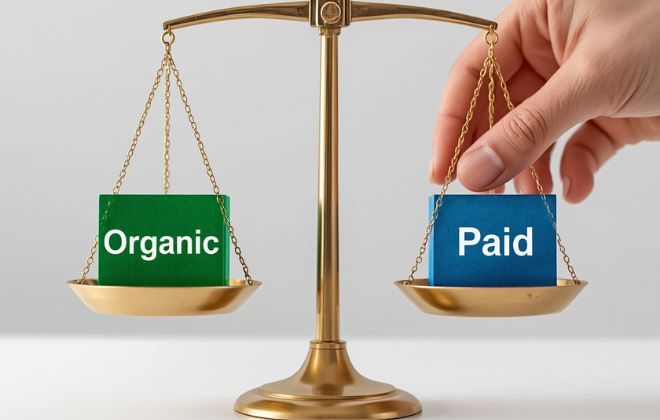
Paid advertising gives you speed and immediate reach. Organic builds long-term trust, authority, and brand equity. One is not better than the other. They serve different purposes, and together they create a system that attracts, acquires, and retains users more effectively.
Organic marketing works when you need trust and credibility now. Thought leadership, customer proof, and consistent presence that your ideal customer profile cannot ignore. Paid advertising works when you need scale that organic cannot imagine. Precise targeting, conversion funnels, retargeting loops.
The real difference is not free versus budget. Organic has guardrails. Paid has possibilities. When teams bet on organic, they are usually solving known problems, building brand and authority, educating buyers. The work is slower, but it pays the bills long term. When teams bet on paid, they are usually chasing what does not exist yet: category creation, aggressive scaling, instant market entry.
According to Ashvini Vyas, a growth marketing strategist who has worked with over 50 SaaS teams, the question is not which is better. The question is, “Which one will still bring leads at 3 am when your pipeline is dry? Completely dry.”
The “Earned First” Model
One effective framework for combining paid and organic is the “earned first” model. Here is how it works:
Run small earned moments first. This could be influencer collaborations, dark social drops, or organic buzz. Test the message against a real audience in a real feed. Once a message earns stronger signals, amplify it with paid.
This approach separates two jobs that paid ads often confuse. Every new paid ad asks the audience two questions at once: “Do you want this message?” and “Do you want this product?” When the ad underperforms, most teams cannot tell which question it answered.
Organic testing removes that guesswork. For example, an ecommerce team can test three to five angles per product: pain point, comparison, routine, customer objection, and transformation. The version that earns stronger retention and decision signals tells the team how to lead with that message when budget goes behind it.
Organic signals that predict paid performance include save rate, comment quality, and profile-to-link click ratio. Saves suggest the message earned enough trust or utility for someone to return later. Comments asking about sizing, shipping, or price tell the team what the next variation needs to answer. These metrics are more useful for making paid decisions than views or likes.
The Founder-Led Growth Loop
Another powerful integration strategy is the founder-led growth loop. This connects organic resonance and paid performance in one framework designed to turn thought leadership into predictable revenue.
Your founder provides the authentic voice. Your job as the marketer is to amplify that voice to the entire market and build the measurement framework that proves it works. This is how you turn a content strategy into a scalable, predictable, full-funnel growth loop.
The most efficient paid strategy is amplifying what is already working organically. Why guess what might work when you can use data to amplify what is already working?
On LinkedIn, Thought Leader Ads are a high-performing format for this. They let you promote posts from individuals, founders, employees, and even customers, rather than just your company page. They look and feel like organic posts: authentic, human, and scroll-stopping.
The impact is significant. Thought Leader Ads result in 1.5 times higher click-through rates, 30 percent more efficient cost-per-click, and two times follower growth. For startups, the impact is even bigger: 7.6 times more engagement than any other paid ad format, and five times higher video engagement with video Thought Leader Ads than regular sponsored video ads.
The measurement framework for this approach includes tracking leading indicators like engagement quality, audience growth, and conversation starters in the first 90 days. Then, momentum metrics like prospect mentions, dark social mentions, and content-influenced deals. After six months, business impact metrics like increasing inbound pipeline, deal velocity, and category ownership.
The Organic Social Testing Loop
For ecommerce brands, one practical way to combine paid and organic is the organic social testing loop. Use organic social as a testing layer before paid, not just cheaper reach.
The unit of work is simple: one product, one claim, one test. A cleaner test has three constants and one variable. Keep one product fixed. Keep one claim fixed. Keep one format fixed, such as a demo, comparison, or before-and-after. Then vary the hook two or three times.
For example, a coffee brand testing a freshness claim could run three versions of the same product video: a problem statement, a sensory demonstration on camera, and a side-by-side with a typical grocery brand. Same product, same claim, three different opening moves.
The version that earns stronger retention and decision signals tells the team how to lead with freshness when budget goes behind it.
A practical weekly rhythm looks like this:
- Monday: Review last week’s clips and pick the top signals
- Tuesday: Turn those signals into new scripts or creator prompts
- Wednesday and Thursday: Film or brief the content
- Friday: Publish one or two tests and document the hypothesis
This rhythm prevents the team from starting from zero every week. The calendar becomes a record of learning, not just a list of posts.
The Synergy Effect: How Paid Boosts Organic
There is a real synergy effect where paid activity can actually improve organic performance. This happens through three core mechanisms.
Signal reinforcement. When users download your app or visit your site through paid ads and exhibit positive behaviors, this sends a positive signal to search algorithms, indicating that your content is relevant and high quality, which helps improve organic rankings.
Cognitive accumulation. Continuous ad exposure enhances users’ awareness of your brand. When users see your content again in organic search results, their click-through intention significantly increases. The organic click-through rate is an important factor influencing ranking.
Heat conduction. Advertising for specific keywords increases their search popularity, indirectly affecting the competitive environment of the entire keyword field and creating opportunities for related content.
This means that investing in paid can create a lift in organic performance over time. The key is not to look at paid and organic data separately but to focus on their interlinked changes.
Connecting Paid, Owned, and Earned Channels
When paid, owned, and earned media are connected, every channel reinforces the next, improving efficiency, consistency, and growth. Success comes from strategic integration, not channel isolation.
SEO captures organic traffic across the funnel. Optimize for informational, commercial, and transactional search intent. Build content that addresses customer needs through guides, comparisons, and reviews. Use internal linking to move users from research to conversion.
SEM drives growth with smarter ad alignment. Segment campaigns for new users and returning customers. Sync search and display activity with CRM and email data for more precise targeting. Use dynamic retargeting to re-engage visitors who viewed specific products. Bid more aggressively on high-intent keywords where organic rankings are lower.
Social combines paid reach with organic influence. Use user-generated content and influencer advocacy to build trust. Run paid prospecting for new audiences, with retargeting for engaged users. Develop organic content that educates and inspires, not just sells.
Email and SMS create a connected, personal experience. Use first-party data to tailor messaging and timing. Automate nurture flows that guide customers from consideration to purchase. Trigger real-time campaigns from behavioral signals.
When connected to search and social activity, these channels close the loop, turning traffic into relationships and relationships into repeat sales.
Key Takeaways
- Growth marketing is systematic. It is not about hacks or one-off campaigns. It is about building a system where paid and organic reinforce each other.
- Use organic as a testing layer. Test messages organically first, then amplify what works with paid. This removes the biggest guess from your paid creative.
- Amplify what is already working. The most efficient paid strategy is built on organic content that has already resonated.
- Share learnings across teams. Winning organic hooks can create great paid ads. Paid performance data can inform organic content strategy.
- Measure the whole journey. Do not isolate paid and organic metrics. Track how they interact and reinforce each other.
- Paid can boost organic. Advertising for keywords can improve organic rankings over time through signal reinforcement and cognitive accumulation.
- The best answer is both. Organic works when you need trust and credibility now. Paid works when you need scale that organic cannot imagine.
Datawyze is a performance marketing agency that helps brands measure what actually drives revenue. We specialize in ROAS optimization, paid search management, and helping businesses navigate the shift from rankings to citations in AI search. Our data-driven approach ensures your marketing spend delivers real results, not vanity metrics. Learn more at datawyze.com.