How to Create a Wikipedia Page for Your Brand in 2026
Creating a Wikipedia page for your brand is not a quick marketing win. It requires meeting strict notability guidelines, gathering substantial independent sources, and writing from a neutral point of view. The entire article is then scrutinized by volunteer editors through the Articles for Creation process. It is a complex journey that demands patience and a deep understanding of Wikipedia’s core policies.
Why Wikipedia Still Matters in 2026
Not long ago, brands sought Wikipedia pages primarily for SEO backlinks and search ranking boosts. Today, the strategic value has shifted. The goal is no longer just ranking on Google. It is about becoming a foundational source of truth for the AI models that now drive information discovery.
When a user asks ChatGPT or Perplexity a question about your company, the AI scours trusted sources to construct its answer. In this ecosystem, Wikipedia is a primary authority. Research shows that Wikipedia accounts for nearly 48 percent of top-cited sources in ChatGPT factual responses, with similar dominance appearing across Claude, Perplexity, and Google AI Overviews . Wikipedia presence is effectively a prerequisite for appearing in AI-generated answers.
A well-sourced Wikipedia page allows you to directly inform how these AI systems understand and represent your brand. This discipline is part of what experts call Answer Engine Optimization (AEO), where the objective is to ensure your brand is the definitive answer when potential customers ask questions.
Every Wikipedia article now serves two critical audiences. First, AI models rely on the platform’s massive, high-quality knowledge base of over 65 million articles as a primary training ground for large language models. Second, human readers still turn to Wikipedia as the go-to destination for neutral, verifiable information without marketing spin .
A strong digital presence anchored by an authoritative asset like a Wikipedia page directly feeds into how AI systems like ChatGPT, Gemini, and Perplexity understand and present your brand. This makes it a critical component of modern digital strategy.
The Notability Test: Does Your Brand Qualify?
Before you go any further, be clear on this point. Most companies will never have a Wikipedia page. This is not an opinion. It is a reality baked into the encyclopedia’s core principles. Wikipedia is an encyclopedia, not a business directory or a marketing platform. It is governed by one powerful principle: notability .
A topic earns a page only if it has received significant coverage in reliable sources that are independent of the subject .
Significant Coverage means sources that discuss your brand in substantive detail. A passing mention or a quote from your CEO in a broader industry trend piece does not count. There must be enough material for someone to write a balanced article from that coverage alone.
Reliable Sources refers to publications with a known reputation for fact-checking and editorial oversight. Examples include major newspapers, peer-reviewed academic journals, books from respected publishers, and top-tier technology or business media.
Independent of the Subject is the most common point of failure. The source cannot have any affiliation with your brand. This disqualifies your own website, press releases, company blogs, sponsored content, and interviews you have paid for or arranged.
If your brand’s media presence consists mainly of content you have created or paid for, you do not meet the notability guideline. It is a harsh but unavoidable part of the process.
Step 1: Audit Your Existing Coverage
The first critical step is to audit your existing press coverage. Many are surprised to learn that a celebrated PR win is worthless for establishing Wikipedia notability.
A feature in a major newspaper like The New York Times or The Wall Street Journal is the gold standard. It is independent, has editorial oversight, and provides significant coverage . Your company’s website is not independent and cannot be used to prove notability. Press releases are explicitly promotional and controlled by the subject. Paid or sponsored content does not count as independent coverage. A brief mention of a new hire in a local newspaper may not help, but a detailed profile of the company’s local economic impact could.
After your audit, you should have a clearer picture. You are looking for a handful of high-quality, in-depth sources, not a high quantity of low-value mentions.
Step 2: Gather and Organize Your Sources
If you are confident your brand passes the notability test, the next phase is to gather and organize the evidence. You are building an airtight case file to withstand the scrutiny of experienced editors.
Use advanced search operators to filter out noise. For example, search for your brand name while excluding your own site and press release aggregators. Search for your brand name in article titles to find pieces where you are the main subject. Explore academic databases like JSTOR or Google Scholar. A single mention in a peer-reviewed journal can carry more weight than five online articles .
With your sources collected, build an evidence map. This simple spreadsheet is a powerful tool for connecting every factual claim in your article to a specific, high-quality source. Your evidence map should include columns for the claim, the source publication, the URL or identifier, and a direct quote from the source that proves the claim .
This structured work makes the writing process significantly easier, as you are assembling a puzzle with pre-verified pieces. It also serves as your final reality check. If you struggle to fill this spreadsheet with multiple independent sources for your most important claims, it is a major red flag.
Step 3: Disclose Your Conflict of Interest
You must be transparent about your affiliation. Wikipedia’s Conflict of Interest (COI) policy is strict. If you are an employee, founder, or paid marketer, you have a COI.
This does not ban you from participating. However, it requires that you must disclose your affiliation. You are expected to state your connection on your user page and on the Talk page of the article draft.
Attempting to edit anonymously or hide your connection is a serious breach of community trust. It often leads to your account being blocked and the article being deleted, sometimes with prejudice, making it harder to try again. For brands, total transparency is the only viable approach.
Step 4: Write Your Draft in the Sandbox
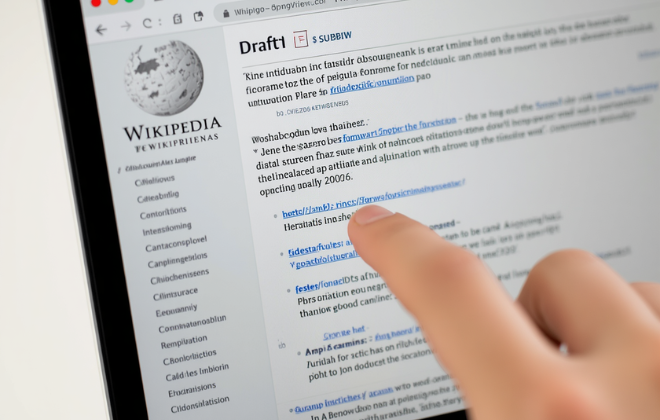
With your sources organized, it is time to write. Do not create a page directly in the live encyclopedia. Instead, create a Wikipedia account and use your personal Sandbox or the Draft namespace. These are designated safe zones where you can draft, format, and cite your article without public scrutiny or the risk of speedy deletion .
Wikipedia encourages this practice, as it prefers users to learn the rules in a low-stakes environment before publishing.
Mastering Wikipedia’s Neutral Point of View (NPOV) policy is the greatest challenge. This is where most company-led efforts fail. You must remove all promotional, laudatory, or persuasive language and adopt a dry, encyclopedic tone. Your job is to report what reliable sources have published, not what your marketing team wishes were true.
If a sentence sounds like it came from your marketing department, it needs to be rewritten or cut. For example, instead of saying “Our groundbreaking platform is a revolutionary force in the industry,” a neutral version would say “Industry publication Global Tech Weekly described the platform as a significant development in the sector.”
Step 5: Submit Through Articles for Creation
Your polished, neutral, and well-cited draft is ready. Most new articles go through the Articles for Creation (AfC) process, a gateway managed by volunteer editors working through a massive backlog .
Submit your draft for review by clicking the submit button or adding the appropriate code to your draft. Getting a review can take a while. The backlog can range from a few weeks to several months.
Attempting to bypass the process by moving the page directly into this page may lead to the page being moved back, deleted, or listed for deletion. Repeated attempts may lead to consequences.
Step 6: Handle Feedback and Rejection
Your article will probably be rejected on its first submission. This is normal and not a final verdict. It is part of the collaborative process. Very few newcomers master Wikipedia’s complex policies on the first try.
Think of a rejection not as a failure, but as a specific, actionable punch list from an expert. The reviewer is telling you exactly what needs to be fixed.
If a reviewer says “lacks significant coverage,” the problem is that your sources are not strong enough to prove the subject deserves an encyclopedia entry. Find better sources. Do not argue the point. If the reviewer says “reads like an advertisement,” remove all marketing language. Words like “innovative,” “leading,” and “best-in-class” must go. Replace them with dry, factual statements supported by citations. If the reviewer questions your sources, remove every weak source and replace claims with citations from reputable newspapers, academic journals, or respected industry media .
After thoroughly addressing every point, you can resubmit. Leave a brief, polite note for the next reviewer in the edit summary or on the draft’s Talk page. This gesture shows you are engaged and respectful, turning a frustrating rejection into a productive dialogue.
Step 7: Maintain Your Page Over Time
A Wikipedia page is not a static asset. It can be edited by anyone, and over time it will accumulate additions, deletions, and changes made by editors unconnected to the brand. Volunteers continuously review pages, so you should monitor a live page and keep it updated with strong, independent citations .
When problems arise such as factual errors, outdated information, or unbalanced tone, the correct engagement path is the article’s Talk page. Brand representatives can flag issues, suggest corrections, and provide sources, with the expectation that neutral editors will evaluate the suggestion and make changes if warranted. Direct editing by brand representatives violates COI policy.
Occasionally a Wikipedia article evolves in ways the brand finds unfavorable. Wikipedia is not obligated to present the brand favorably. If claims are factually wrong, the Talk page process can produce corrections. If the claims are factually correct but unfavorable, the brand cannot have them removed.
Datawyze: Human-Written Content That Builds Authority
At Datawyze, we understand that authoritative content starts with human expertise. Unlike the low-quality, AI-generated content that floods the web and gets ignored by AI models, our content is researched, written, and refined by experienced professionals who understand what both search engines and AI systems actually value.
When you create a Wikipedia page or any authoritative asset, you need content that stands up to scrutiny. You need sources that are credible, writing that is neutral, and research that goes beyond surface-level information. That is what Datawyze delivers. We help brands measure what actually drives visibility and revenue, not vanity metrics.
Wikipedia editors and AI systems alike can tell the difference between content written by people who understand a subject and content churned out by automation. Human-written content builds the kind of trust that leads to citations, whether from volunteer editors or language models.
Frequently Asked Questions (People Also Ask)
Q: How do I create a Wikipedia page for my brand?
A: Create a Wikipedia account, use your Sandbox to draft a neutral, well-sourced article, disclose any conflict of interest, and submit through the Articles for Creation process. Expect review and potential rejection before approval.
Q: What makes a brand notable enough for Wikipedia?
A: Significant coverage in multiple reliable sources that are independent of the subject. Press releases, paid content, and your own website do not count .
Q: Can I pay someone to create my Wikipedia page?
A: Yes, but you must disclose it. Wikipedia’s paid contribution disclosure policy requires anyone compensated for edits to declare their relationship publicly. The best-case outcome of hiring a paid editor is often worse than not having a Wikipedia article at all .
Q: How long does Wikipedia approval take?
A: The Articles for Creation process is managed by unpaid volunteers with no guaranteed response times. The backlog can range from a few weeks to several months. Expect the entire process to take 3 to 9 months .
Q: What should I do if my article gets rejected?
A: Treat the rejection as actionable feedback. Address each point raised by the reviewer, strengthen your sources, remove promotional language, and resubmit with a polite note explaining your changes .
Q: Can I edit my own company’s Wikipedia page?
A: You can, but it is strongly discouraged. Wikipedia’s conflict of interest policy requires disclosure, and direct editing often leads to scrutiny, deleted content, or reputational damage. Use the Talk page to suggest changes instead .
Q: What sources count for Wikipedia notability?
A: Major newspapers, peer-reviewed academic journals, books from respected publishers, and top-tier business media. Press releases, paid placements, sponsored content, and your own website do not count .
Q: Why does Wikipedia matter for AI visibility?
A: Wikipedia accounts for nearly 48 percent of top-cited sources in ChatGPT factual responses. AI models treat Wikipedia as a primary authority, making it a prerequisite for appearing in AI-generated answers .